

 This was originally posted 4 years ago. Opinions, facts and reality may have changed.
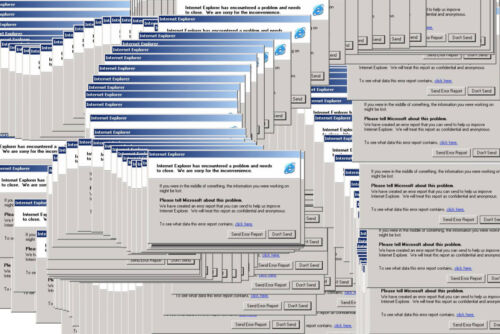
It’s a product that began life with the best of intentions. Well, not really. It was designed to crush smaller opposition and jump on the web bandwagon that had begun rolling. And then, after scaling the heights to practical ubiquity, it finally collapsed under the weight of its own inadequacies. If you speak to any web developer over 35 about their experiences with Internet Explorer (IE), be prepared for tears. The pain of working with it was very real.
IE was a horrible browser. Even in its early days. But with the weight of the Microsoft powerhouse behind it, it was always going to reign supreme. Temporarily anyway.
Back in 1995, the world was a simpler place and the World Wide Web was a new toy, a thing of shiny wonder. And if you wanted to go “online” you used Netscape. There were other browsers but, frankly, nothing could compete with Netscape. It was effective, efficient and the perfect guide for the exciting new world of websites.
Originally Microsoft and Bill Gates didn’t see any value in getting involved in the web but that soon changed when Netscape began to gain traction, and thus Internet Explorer was fast tracked, finally being pushed out into the world as part of the Internet Jumpstart Kit released as an add-on to Windows 95.
Netscape charged money for its browser. Internet Explorer was made available for free not soon after its launch — and eventually bundled as part of Windows. Who was going to pay for Netscape when IE was free?
The inevitable happened, Microsoft’s near monopoly on the PC translated into almost universal adoption for Internet Explorer as everybody’s default browser.
Netscape’s 80 per cent market penetration tumbled to 30 per cent by 1999, and then 3 per cent by 2002.
By that point IE was on version 6, a piece of software generally considered as one of the worst tech products of all time, with PC World magazine labelling it “the least secure software on the planet.”
But when 90 per cent of web users were using it – did Microsoft care? It took five years for IE7 to make an appearance, by which point Netscape had been reborn as first Phoenix, then Firebird and then Firefox and began nibbling away at Microsoft’s market share.
The problem with IE6 was simple: it held back the development of new web technologies. There was no point doing something technically clever if 90 per cent of your users wouldn’t be able to see it or use it. There’s many times around the turn of the millennium that I had to develop two versions of a website. One that IE6 users would see and the infinitely better/nicer/sexier version for everybody else.
The market share for IE6 in 2008 – when IE7 had been out 2 years and IE8 was around the corner – was still almost 40 per cent. You couldn’t ignore it.
Eventually IE was hung by its own inadequacies when Google launched Chrome, which not only embraced new available technologies but, being separated from a desktop operating system, could be updated as regularly as required (do you even know what version of your web browser you’re using any more? I had to check and I’ve got Safari 14, Firefox 101 and Chrome 103 on my main machine).
So, goodbye and good riddance Internet Explorer. You should have known the writing was on the wall when even Microsoft replaced you – with the Edge browser in 2015 – but you hung on didn’t you. You were still hidden in the latest versions of Windows to “maintain compatibility” with old websites using outdated Microsoft only web technologies… but we all knew this day would come.